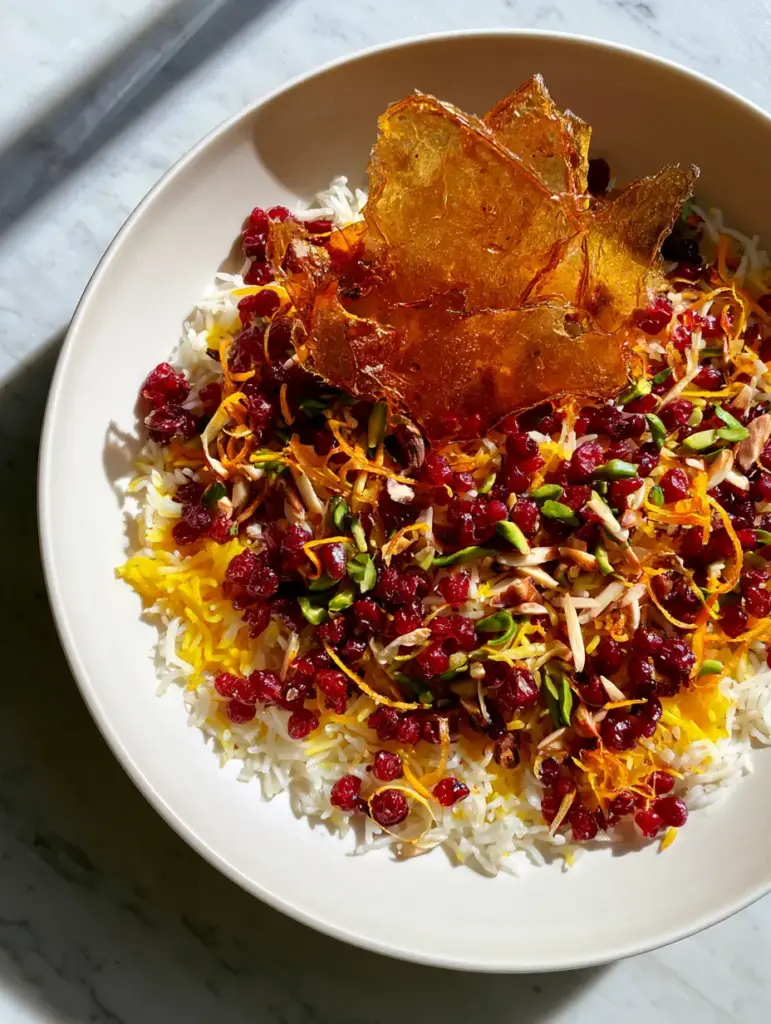
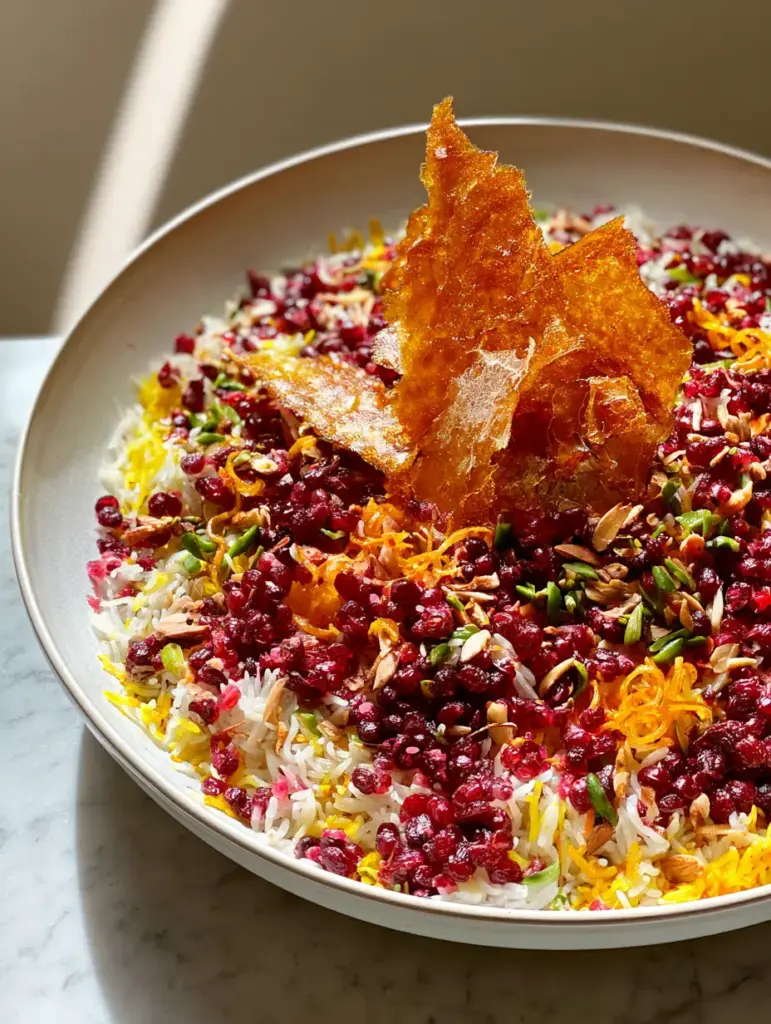
Persian Jeweled Rice, known traditionally as Javaher Polo, is not merely a side dish; it is the undisputed crown jewel of Persian cuisine. This vibrant mosaic of colors and textures represents a celebration on a plate, featuring fluffy long-grain basmati rice marbled with vivid saffron-yellow grains. Every forkful offers a sophisticated balance of sweet candied orange peel, tart ruby-red barberries, and the earthy crunch of emerald pistachios and toasted almonds.
The visual centerpiece of this masterpiece is the tahdig—a thick, shattered crust of deep honey-gold potato that crackles with every bite. To achieve the stunning result seen in our high-angle close-up, we focus on the contrast between the glistening oils on the barberries and the glass-like texture of the caramelized potato shards. This recipe is designed for home cooks who want to master the delicate art of Persian steaming while achieving professional-level aesthetic results.
Essential Components for a Royal Rice Mosaic
Creating an authentic Persian Jeweled Rice requires a specific set of high-quality ingredients that provide both the visual “jewels” and the structural integrity of the rice. We start with long-grain basmati rice, which must be aged to ensure each grain remains distinct and elongated after steaming.
For the vibrant yellow marbling, we use premium Persian saffron threads bloomed in warm water to create a deep, aromatic infusion. The “jewels” consist of dried ruby-red barberries (zereshk), slivered green pistachios, and toasted blanched almonds, providing a spectrum of colors that mimic precious stones. Finally, the candied orange peel strips add a citrusy brightness that cuts through the richness of the butter and oils.
While this dish is a standalone star, it pairs beautifully with other regional classics like Persian Chicken or a hearty Persian Kotlet. If you are a fan of complex grain dishes, you might also enjoy exploring the spice profiles of Jollof Rice or a smoky Cajun Sausage and Rice Skillet.
Foundational Ingredients for the Perfect Javaher Polo
Long-Grain Basmati Rice: Use 3 cups (600g) of high-quality, aged basmati. The extra-long grains are essential for the fluffy, non-sticky texture required for a traditional Persian presentation.
Dried Ruby-Red Barberries (Zereshk): 1/2 cup (60g) of these tart berries provides the signature red “rubies.” They must be rehydrated and sautéed briefly to make them glisten like the oils in the visual prompt.
Saffron Threads: 1/2 tsp (approx. 1g) of high-grade saffron, ground and bloomed. This provides the vivid yellow contrast against the snow-white steamed rice.
Slivered Pistachios and Almonds: 1/3 cup (50g) of each for the “emerald” and “pearl” components. Toasting the almonds is a critical step for developing the deep, nutty flavor that balances the sweet fruit.
Candied Orange Peel: 1/4 cup (40g) of thin orange zest strips, blanched and simmered in sugar. This removes bitterness while adding a translucent, curled aesthetic to the dish’s surface.
Russet Potatoes: 2 large potatoes, peeled and sliced into 1/4 inch (6mm) rounds. These are the foundation of the thick, shattered shards of deep golden-brown crispy potato tahdig.
Neutral Oil and Butter: A combination of 4 tbsp (60ml) oil and 2 tbsp (30g) butter is used to sear the potatoes into a glass-like crust and to keep the rice grains separated.
Professional Tools for Tahdig Mastery
To achieve the deep caramelized honey-gold color and jagged, crunchy texture of the tahdig, you need a heavy-bottomed non-stick pot or a traditional Persian rice cooker. A wide, minimalist white ceramic bowl is recommended for serving, as it highlights the glistening colors of the jeweled toppings against the light gray marble surface.
A fine-mesh strainer is vital for rinsing the rice until the water runs clear, which removes excess starch. You will also need a clean kitchen towel to wrap the pot lid, a technique known as “damkoni,” which traps steam and prevents moisture from dripping back onto the rice, ensuring every grain is perfectly fluffy.
Mastering the Art of Steaming and Saffron Infusion
Preparation of the Jeweled Toppings
Start by rinsing the barberries in cold water to remove any grit, then soak them for 10 minutes. In a small skillet, melt 1 tbsp (15g) of butter with 1 tsp (5g) of sugar, then briefly sauté the barberries until they plump up and glisten; do not overcook or they will turn dark brown.
For the orange peel, boil the zest strips in water three times, changing the water each time to remove bitterness. Simmer the softened strips in a simple syrup (equal parts sugar and water) for 5 minutes until translucent and curled, then drain and set aside with the pistachios and toasted almonds.
Parboiling the Basmati Rice
Bring a large pot of water to a rolling boil and add a generous amount of salt—it should taste like the sea. Add the rinsed rice and boil for 6-8 minutes, stirring occasionally. Look for the visual cue: the grains should be softened on the outside but still have a firm “bite” or “al dente” core in the middle.
Immediately drain the rice in a colander and rinse with a splash of lukewarm water to stop the cooking process. This step is crucial for preventing the grains from clumping together in the final steaming stage.
Building the Crispy Potato Tahdig
In your heavy-bottomed pot, heat the oil and a splash of the bloomed saffron water over medium heat. Arrange the potato slices in a single, tight layer across the bottom of the pot, ensuring they are fully coated in the golden oil.
Gently mound the parboiled rice over the potatoes, shaping it into a pyramid. Use the handle of a wooden spoon to poke 5-6 holes through the rice to the bottom of the pot, allowing steam to escape and circulate evenly throughout the cooking process.
The Final Steam (Damkoni)
Wrap the pot lid in a clean kitchen towel and cover the pot tightly. Cook on medium-high heat for 5-7 minutes until you see steam escaping from the sides, then reduce the heat to low and steam for 45-50 minutes. This slow process is what creates the deep honey-gold color and crunchy, glass-like texture of the potato tahdig.
Once finished, remove about one cup of the white rice and mix it with the remaining bloomed saffron to create the vivid yellow marbling. Gently fluff the remaining white rice onto your serving platter, layering in the jeweled fruit and nut mixture as you go.
Expert Tips for Success
- The Rinsing Rule: Never skip rinsing the rice; you must wash away the surface starch until the water is crystal clear to achieve the individual grain definition seen in the prompt.
- Saffron Quality: Use real saffron threads, not powder. The fragrance and the specific “saffron-yellow” color are impossible to replicate with food coloring or turmeric.
- Tahdig Release: If the potato tahdig feels stuck, place the bottom of the hot pot in a sink of cold water for 30 seconds to create a steam release that pops the crust loose.
- Temperature Control: Avoid the temptation to check the rice by lifting the lid during the steaming process, as this releases the essential heat needed for the tahdig to crisp.
Storage, Reheating, and Freezing Advice
Persian Jeweled Rice is best enjoyed fresh to appreciate the crunch of the tahdig, but leftovers can be stored in an airtight container in the refrigerator for up to 3 days. To reheat, add a tablespoon of water and microwave covered, or heat in a skillet with a little butter to help revive the texture of the rice.
While the rice itself freezes well for up to a month, the crispy potato tahdig will lose its jagged, crunchy texture upon thawing. If you plan to freeze portions, we recommend doing so without the tahdig shards for the best results.
What to Serve With This Royal Dish
Javaher Polo is traditionally served at weddings and celebrations, often paired with roasted meats. It is the perfect accompaniment to a Persian Yogurt Rice with Lamb for a multi-textured feast. For a lighter pairing, consider Pan-Seared Rainbow Trout or even Shrimp and Avocado Bowls for a modern fusion twist.
If you are hosting a large gathering with diverse tastes, you could serve this alongside Nigerian Party Jollof Rice to showcase the beautiful variety of global rice traditions. The bright acidity of a shirazi salad (cucumber and tomato) also perfectly complements the rich, buttery notes of the saffron rice.
Frequently Asked Questions
If you cannot find zereshk (barberries), dried cranberries soaked in lemon juice are a common substitute, though the flavor will be slightly sweeter.
Yes, candying is essential to remove the natural bitterness of the zest and create the sweet-tart balance that characterizes an authentic Persian Jeweled Rice.
The key is using enough oil and ensuring you use the ‘damkoni’ method (a towel-wrapped lid) to prevent steam from turning into water droplets that soften the crust.
Unlike other dishes, Javaher Polo is defined by its ‘jewels’ (fruit and nuts) and the presence of Tahdig, a deliberate crispy crust formed at the bottom of the pot.
This is usually due to insufficient rinsing or using low-quality rice. Always rinse basmati until the water is clear and choose a high-quality, aged variety.
Recipe for Authentic Persian Jeweled Rice (Javaher Polo)
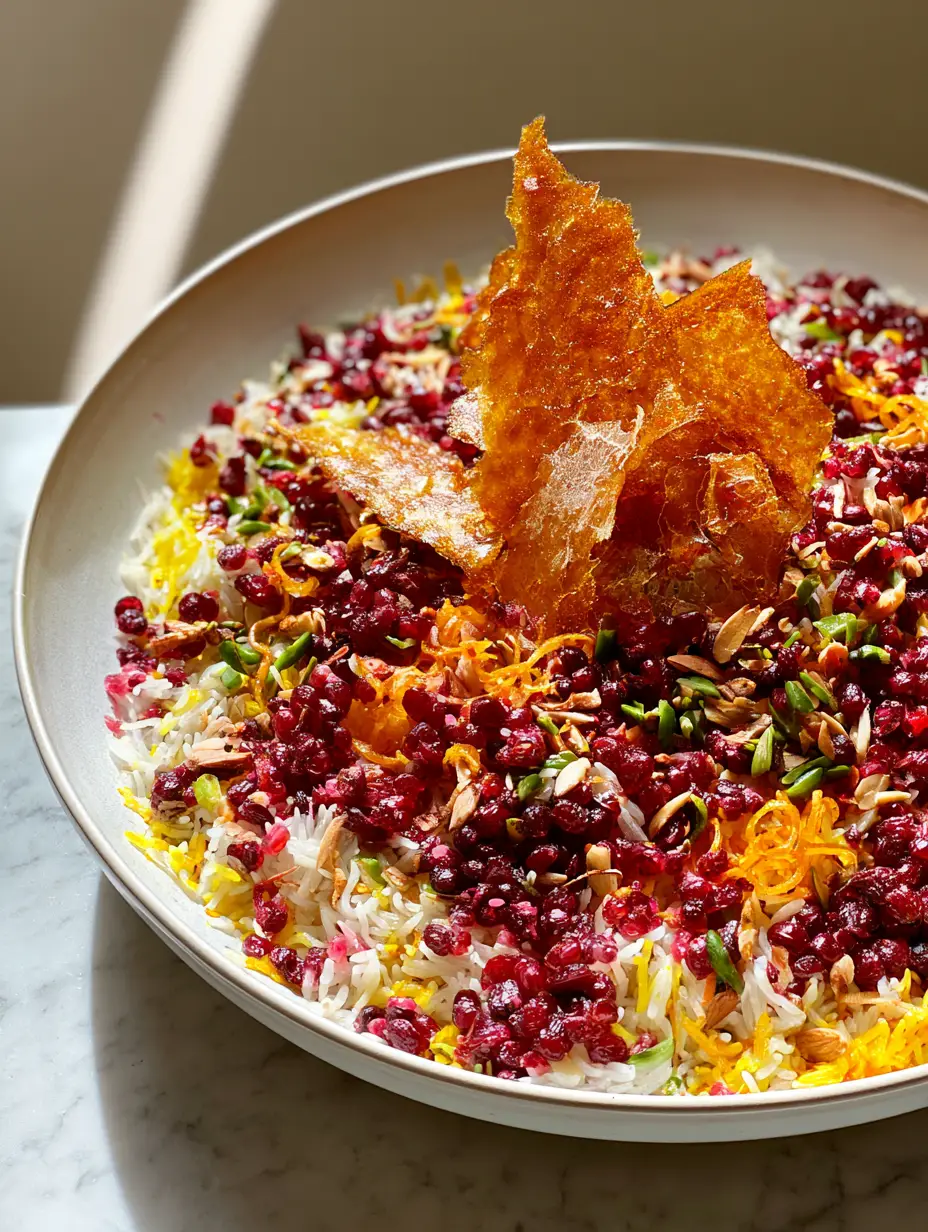
Persian Jeweled Rice: The Ultimate Guide to Javaher Polo with Crispy Potato Tahdig
Ingredients
Equipment
Method
- Rinse rice until water is clear. Parboil in salted water for 6-8 minutes until al dente, then drain.
- Sauté barberries with sugar and butter until glistening. Blanch and candy the orange peel strips.
- Heat oil in pot, add potato slices in a single layer. Mound rice on top in a pyramid shape.
- Wrap lid in a towel. Cook on medium-high for 5 minutes, then low for 45-50 minutes until tahdig is deep honey-gold.
Notes
Always bloom saffron in warm (not boiling) water for the best aroma.
Share Your Culinary Creation!
We hope this guide helps you create a Persian Jeweled Rice that looks just as stunning as the one in our marble-top photo. The combination of shattered tahdig shards and glistening fruit jewels is sure to impress any guest. If you enjoyed this recipe, please leave a comment below and share your results with us on Pinterest. Happy cooking!