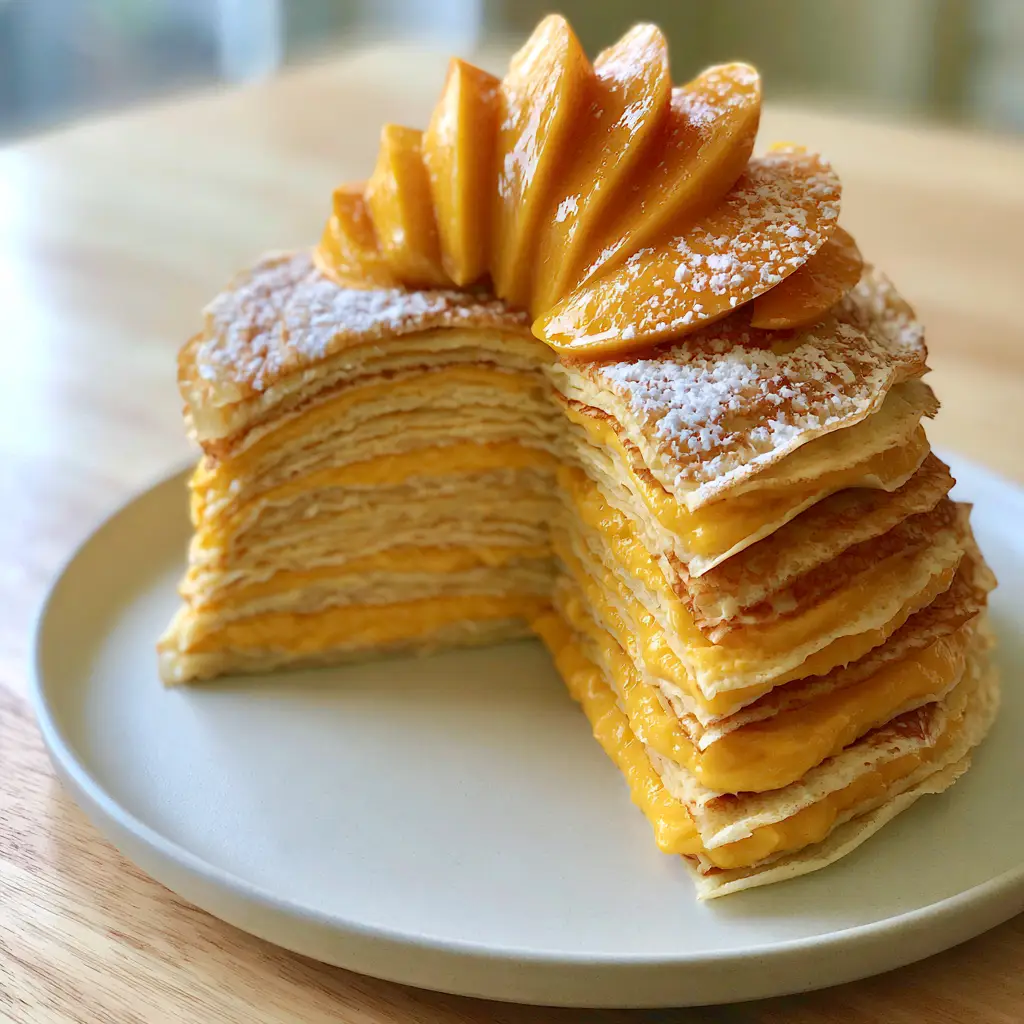
The Mango Crepe Cake is a breathtaking architectural marvel of the dessert world, combining the delicate finesse of French pastry with the vibrant, sun-drenched flavors of the tropics. This specific iteration focuses on achieving twenty paper-thin, golden-brown layers, each separated by a velvety, saffron-orange mango-infused pastry cream that melts on the tongue.
Inspired by the classic mille crepe, our version utilizes high-quality Alphonso mangoes to provide a deep, saturated color and an unmatched floral sweetness. Whether you are hosting a summer garden party or looking for a show-stopping centerpiece, this cake delivers a professional bakery aesthetic straight from your home kitchen.
The visual appeal is undeniable: a side profile reveals perfectly uniform internal striations, while the top is crowned with a glossy mango glaze and expertly fanned fresh mango slices. Every bite offers a texture that is simultaneously light, creamy, and structurally sound, making it a favorite for those who appreciate culinary precision.
Why This Tropical Mille Crepe Cake is the Crown Jewel of Summer Desserts
- Perfectly Uniform Architecture: We utilize a specific layering technique to ensure all 20 crepes sit perfectly flat, creating those iconic, clean lines when sliced.
- Saffron-Orange Vibrancy: By reducing fresh mango puree into a concentrated paste, we achieve a saturated orange hue in the pastry cream without using artificial food coloring.
- Texture Mastery: The contrast between the tender, golden-brown crepes and the stabilized, thick mango custard creates a “melt-in-your-mouth” experience.
- Glossy Professional Finish: A shimmering mango glaze and a light dusting of powdered sugar provide that “high-end patisserie” look that is perfect for social media.

Essential Components for a Structurally Sound Mango Crepe Cake
To achieve the visual result seen in professional photography, every ingredient serves a dual purpose: flavor and structural integrity. You cannot skip the stabilizing elements if you want a cake that stands tall without leaning.
The Foundational Crepe Batter
All-Purpose Flour (250g / 2 cups): Provides the necessary gluten structure to allow the crepes to be flipped without tearing while remaining tender. Ensure you sift the flour to avoid lumps in your 20-layer stack.
Large Eggs (4 units): Acting as the primary binder, eggs give the crepes their elasticity and help achieve those beautiful golden-brown lacy edges. Use room-temperature eggs for better emulsification into the milk.
Whole Milk (600ml / 2.5 cups): The liquid base that thins the batter to a pourable consistency. Using full-fat milk adds a richness that complements the tropical mango notes perfectly.
Unsalted Butter (60g / 4 tbsp), Melted: Provides “shortness” to the batter, preventing the crepes from becoming rubbery. The fat also helps the crepes develop their “golden-brown” visual cue during searing.
Granulated Sugar (30g / 2 tbsp) & Salt (1/2 tsp): Sugar aids in the browning process (Maillard reaction), while salt balances the sweetness of the mango filling.
The Saffron-Orange Mango Pastry Cream
Fresh Mango Puree (300ml / 1.25 cups), Reduced: We start with fresh Alphonso or Kent mangoes, blended and simmered until concentrated. This provides the “vibrant, saturated saffron-orange” color described in our visual blueprint.
Heavy Cream (480ml / 2 cups), Cold: Once folded into the pastry cream, whipped heavy cream provides the “thick, velvety” texture required for stable layers. It lightens the dense custard into a cloud-like mousse.
Egg Yolks (4 units) & Cornstarch (40g / 5 tbsp): These are the thickening agents. The cornstarch is critical for stabilization, ensuring the Mango Crepe Cake doesn’t slide apart when you remove a slice.
Tools Required for Patisserie-Level Results
Achieving “paper-thin” crepes requires more than just a good recipe; it requires the right equipment. A 10-inch (25cm) non-stick crepe pan or a well-seasoned carbon steel skillet is non-negotiable for that even heat distribution.
You will also need a fine-mesh sieve to strain your batter, ensuring it is perfectly smooth. For the layering process, an offset spatula is the secret weapon of professional chefs, allowing you to spread the mango cream to the very edges with microscopic precision.
Finally, a rotating cake stand will make the assembly of your Mango Crepe Cake significantly easier. It allows you to spin the cake while smoothing the sides and top, ensuring a perfectly cylindrical shape.
Step-by-Step Architecture: Building Your 20-Layer Masterpiece
Preparing the Signature Crepe Batter
In a large mixing bowl, whisk together your eggs, sugar, and salt until pale. Gradually incorporate the sifted flour and milk in alternating additions to prevent clumping, then stir in the melted butter.
The most important step for a Mango Crepe Cake is resting the batter. Allow the mixture to sit in the refrigerator for at least 1 hour; this allows the gluten to relax and the air bubbles to dissipate, resulting in crepes that are strong yet delicate.
Searing the 20 Golden-Brown Crepes
Heat your non-stick pan over medium-low heat and lightly brush with oil. Pour approximately 3 tablespoons (45ml) of batter into the center and immediately swirl the pan to coat the bottom in a thin, even layer.
Cook until the edges begin to lift and the bottom is a beautiful golden-brown—usually about 60 to 90 seconds. Flip carefully and cook the other side for only 20 seconds; repeat this process until you have at least 22 crepes (allowing 2 for “practice” or tearing).
Developing the Concentrated Mango Filling
To achieve that “vibrant saffron-orange” filling, simmer your mango puree in a small saucepan over medium heat until it has reduced by half. This intensifies the flavor and removes excess moisture that would otherwise make the cake soggy.
Whisk the reduced puree into a standard pastry cream base made of tempered egg yolks, sugar, and cornstarch. Once the custard has thickened and cooled, gently fold in your stiffly whipped heavy cream to create a stable, airy filling.
Assembling the Mille Crepe Layers
Place your first crepe on a minimalist white ceramic plate. Using your offset spatula, spread a thin, even layer of the mango pastry cream (about 3 tablespoons) across the surface, leaving a tiny margin at the very edge.
Place the next crepe on top, pressing gently with a flat plate or your palms to ensure there are no air pockets. Repeat this until you have stacked all 20 crepes, ensuring the final top layer is the smoothest, most perfectly circular crepe of the batch.
Finishing Touches: The Glaze, the Fan, and the Garnish
A true Mango Crepe Cake isn’t finished until it has its “glossy mango glaze.” Combine a small amount of mango puree with a teaspoon of apricot jam or clear neutral glaze, and spread it thinly over the top crepe.
For the “fresh fanned mango slices,” peel a ripe Alphonso mango and cut the cheeks away from the pit. Slice the cheeks into 1/8th inch (3mm) thick pieces, then gently press them to slide them into a fan shape, placing them elegantly on one side of the cake.
Just before serving, apply a “light dusting of powdered sugar” using a fine-mesh tea strainer. This provides a beautiful contrast against the orange mango. Finally, add a single “fresh mint garnish” for a pop of green that signals freshness to your guests.
Expert Tips for a Flawless Mango Crepe Cake
- Temperature Control: Ensure your pastry cream is completely chilled before folding in the whipped cream. If the custard is even slightly warm, the cream will melt, and your cake will lose its structure.
- The “Chill” Factor: Once assembled, the Mango Crepe Cake MUST set in the refrigerator for at least 4 hours, preferably overnight. This allows the moisture to equalize, making the cake easy to slice into “perfect internal striations.”
- Consistency is Key: Use a small measuring cup or ladle for the crepe batter. Using the exact same amount for every crepe is the only way to ensure they are all the same diameter and thickness.
- Internal Link Inspiration: If you enjoy the delicate layers of this dish, you might also love our Hong Kong Style Mango Pancakes or the airy texture of a Mango Mousse Cake.
Storage, Reheating, and Make-Ahead Advice
The Mango Crepe Cake is an excellent make-ahead dessert. In fact, it tastes better on day two as the flavors of the mango and cream meld with the tender crepes. Keep it loosely covered in the refrigerator for up to 3 days.
We do not recommend freezing a fully assembled crepe cake, as the delicate pastry cream can “weep” or separate when thawed, ruining the texture. However, you can make the crepes in advance and freeze them with parchment paper between each layer for up to a month.
When serving leftovers, ensure the cake stays chilled until the very moment of consumption. Because of the high dairy content in the “thick, velvety mango-infused pastry cream,” it should not sit at room temperature for more than 30 minutes.
What to Serve With Your Tropical Masterpiece
To round out a tropical-themed brunch or dessert spread, consider pairing this cake with other fruit-forward delights. The acidity of a Pineapple Mango Rum Punch cuts through the richness of the cream beautifully.
If you are hosting a larger gathering, you can supplement the cake with smaller bites like Mango Lime Mini Cupcakes or even a refreshing bowl of Mango Bingsu for a variety of textures. For those who prefer something more traditional, our Classic Mango Cake offers a different take on these same flavors.
Frequently Asked Questions
While fresh Alphonso mangoes are best for the ‘fanned’ topping, you can use frozen mangoes for the reduced puree in the pastry cream. Just ensure you simmer it long enough to remove excess water.
The secret is resting the batter for at least an hour to remove air bubbles and using a high-quality non-stick pan. Swirl the batter immediately after it hits the pan to ensure an even, thin coating.
It will stay fresh and delicious for up to 3 days when kept in an airtight container or loosely covered with plastic wrap.
This vibrant hue is achieved by reducing fresh mango puree into a concentrated paste, which intensifies both the natural pigments and the flavor without the need for food coloring.
This usually happens if the pastry cream wasn’t thick enough or if the cake wasn’t chilled long enough. Ensure you use cornstarch to stabilize the cream and refrigerate the cake for at least 4-6 hours before slicing.
The Complete Mango Crepe Cake Recipe
Mango Crepe Cake: The Ultimate 20-Layer Tropical Mille Crepe Recipe
Ingredients
Equipment
Method
- Whisk eggs, sugar, and milk. Gradually add flour and melted butter. Strain through a sieve and rest in the fridge for 1 hour.
- Pour 3 tbsp batter into a hot pan. Swirl to thin. Cook until golden-brown, then flip. Repeat for 20-22 layers.
- Simmer mango puree until reduced by half to achieve a saturated saffron-orange color.
- Make a thick pastry cream with yolks, sugar, and cornstarch. Stir in reduced mango. Chill, then fold in whipped heavy cream.
- Stack 20 crepes, spreading a thin layer of cream between each. Chill for 4 hours to stabilize.
- Top with glossy mango glaze, fanned fresh mango slices, and a light dusting of powdered sugar.
Notes
Chill the assembled cake overnight for the cleanest slices.

Closing & Call to Action
The Mango Crepe Cake is more than just a dessert; it is a labor of love that rewards patience with an incredible sensory experience. From the golden-brown edges of the crepes to the saturated saffron-orange of the cream, every element is designed to impress.
If you enjoyed crafting this 20-layer wonder, please leave a comment below and let us know how your layers turned out! Don’t forget to share your photos and follow us on Pinterest for more culinary inspiration.